Semantic planning, compiled
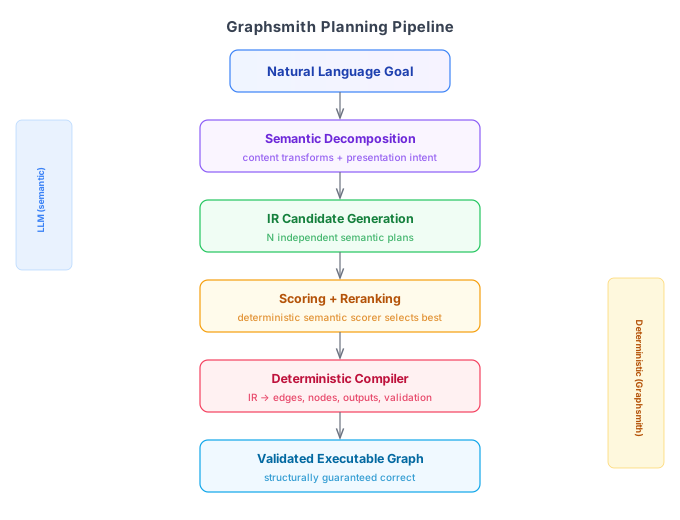
Language models often produce workflows that look plausible but contain missing bindings, invalid control flow, or invented capabilities. Graphsmith gives the model a narrower job: propose semantic intent in a typed intermediate representation. Deterministic machinery then compiles that representation into a graph, validates contracts and control flow, executes it, and records a node-level trace.
The current prototype supports guarded branches, bounded loops, local structural repair, and reusable skills drawn from local or remote registries. When execution exposes a bounded capability gap, the system can generate and validate a missing skill before re-entering the planning loop. Provenance and traces remain attached so that successful structure can be inspected and considered for reuse rather than disappearing inside a single model response.
Current questions
- Can graph representations make generated programs easier to inspect and repair?
- When should a local region be regenerated instead of rebuilding the whole plan?
- Can successful subgraphs become reusable skills with explicit contracts and provenance?
- How should these systems be evaluated beyond narrow task success?
This is an experimental AI-systems project, not yet a general-purpose programming environment. Its capability boundary is deliberate: arbitrary code synthesis and reliable multi-region repair remain open problems. Explore the source code.