Using gravitational waves as a cosmological probe
Most of observational cosmology is built from electromagnetic radiation and the distribution of matter. Those probes are extraordinarily powerful, but they do not give direct access to every epoch: before recombination the Universe was opaque to photons, and many high-energy processes leave no surviving electromagnetic signal. Gravitational waves interact very weakly and can propagate essentially unscattered from the time they were produced.
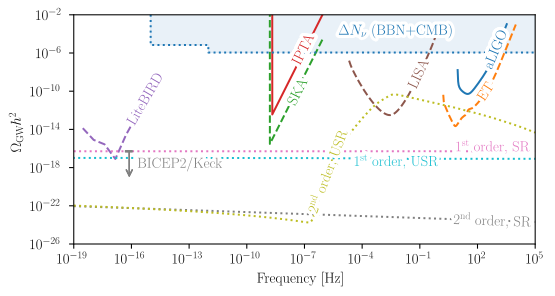
Different production mechanisms populate different frequency bands. Inflationary dynamics, first-order phase transitions, cosmic defects, and second-order scalar perturbations can all create stochastic backgrounds whose shape carries information about the source and the subsequent expansion history. A measured frequency today corresponds to a physical scale—and therefore an epoch—that may be many orders of magnitude smaller than the scales constrained by the cosmic microwave background.
LISA as a cosmology experiment
LISA is an ESA-led space-based gravitational-wave observatory with NASA as a major partner. Its million-kilometre laser interferometer is designed for the millihertz band, between the nanohertz frequencies of pulsar timing arrays and the audio band of ground-based detectors. Alongside compact binaries and massive black-hole mergers, that band gives access to possible stochastic signals from the early Universe.
Extracting such a background is an inference problem rather than a simple curve overlay. Instrument noise, time-dependent detector response, unresolved astrophysical foregrounds, and competing cosmological spectra must be represented jointly. Within the LISA Cosmology Working Group I work on primordial-signal reconstruction; within the Data Distributed Processing Centre (DDPC), I also contribute fiducial cosmological signals for LISA data challenges. That connects theoretical spectra to the realistic analysis machinery needed to identify them in data.
Scalar-induced gravitational waves
Primordial density perturbations source tensor perturbations at second order when they re-enter the horizon. If the curvature power spectrum is strongly enhanced on small scales, the resulting scalar-induced gravitational-wave background can become observable. This creates an indirect window onto inflationary structure far beyond the range measured by the CMB.
The mapping is informative but non-trivial. The gravitational-wave spectrum is a broad, quadratic convolution of pairs of scalar modes, weighted by a transfer kernel that depends on the expansion history. It is therefore not a point-by-point image of the primordial curvature spectrum: narrow input features can broaden, nearby features can mix, and some information is inevitably lost.